How to choose the right conveyor for your factory
Learn how to choose the right conveyor system for your factory in India. Compare belt, roller and inclined conveyors, selection factors and costs.
Learn how to choose the right conveyor system for your factory in India. Compare belt, roller and inclined conveyors, selection factors and costs.
How to Choose the Right Conveyor System for Your Factory in India: A Complete Guide
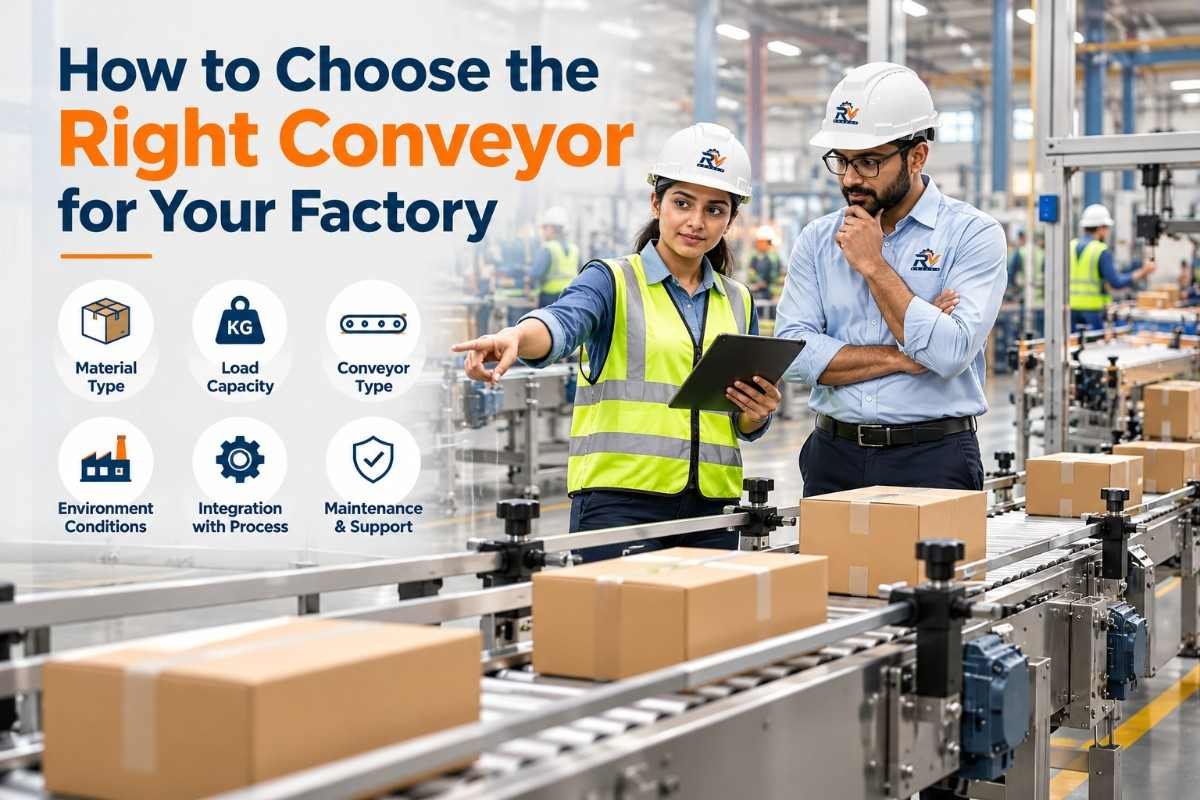
Choosing the right conveyor system is essential for maintaining an efficient production line. The wrong conveyor can create material-handling bottlenecks, increase maintenance requirements, and affect production flow.
For factories in India, selecting the right industrial conveyor depends on several factors, including product dimensions, load capacity, production throughput, conveying distance, factory layout, and operating conditions.
But with different types of conveyor systems available, which one is suitable for your application?
This guide explains the major types of industrial conveyor systems, how to compare them, the factors to consider before purchasing, and how to select a suitable conveyor manufacturer in India.
Looking for the right conveyor solution for your factory? Contact RV PackTech for a free quote.
Quick Answer: How Do You Choose the Right Conveyor System?
To choose the right conveyor system for your factory:
Identify the product's weight, dimensions, shape, and handling requirements.
Calculate the required production throughput and load capacity.
Evaluate conveying distance, speed, incline, and available space.
Consider the operating environment, hygiene, and maintenance requirements.
Compare suitable conveyor types, customization options, and total ownership costs.
Select a conveyor manufacturer in India that can meet your technical and operational requirements.
1. What Is a Conveyor System and Why Is It Used?
In a factory, conveyor systems connect different workstations and help move materials through manufacturing, assembly, packaging, and dispatch processes. Their configuration depends on the type of product, required movement, and production layout.
Industrial conveyor systems help streamline production workflows, reduce unnecessary manual handling, and connect different stages of manufacturing and packaging operations.
They are commonly used in:
Manufacturing and assembly lines
Food processing and packaging industries
Warehouses and distribution centres
Carton and box handling operations
Material handling and logistics
Industrial production facilities
Selecting suitable material handling equipment helps improve workflow consistency, organize product movement, and make better use of available factory space.
2. Types of Industrial Conveyor Systems and Their Applications
Different conveyor types are designed for different material-handling requirements. Understanding their functions and applications helps you make an informed selection.
A. Belt Conveyor
A belt conveyor uses a continuous moving belt to transport products between different points. It is commonly used for cartons, packages, components, and other products across production and packaging lines.
Common applications:
Packaging and carton handling
Manufacturing assembly lines
Product transportation between workstations
General material handling
For packaging operations requiring continuous product movement, a suitable belt conveyor for packaging can support organized transportation between different production stages.
Explore our industrial belt conveyor solutions.
B. Roller Conveyor
A roller conveyor uses a series of rollers to move products along a defined path. Depending on the application, it can operate through gravity or a powered drive mechanism.
Common applications:
Carton and box transportation
Warehouse material handling
Packaging and dispatch areas
Movement of products between workstations
Roller conveyors are suitable for compatible products with stable bases and appropriate dimensions.
Explore our roller conveyor systems for industrial material handling.
C. Spiral Gravity Roller Conveyor
A spiral gravity roller conveyor is designed to move compatible products between different elevation levels through a spiral conveying path. It can help utilize vertical space in facilities where floor space is limited.
Common applications:
Multi-level material movement
Carton handling
Packaging and warehouse operations
Explore our spiral gravity roller conveyor for vertical material movement.
D. Inclined Conveyor
An inclined conveyor transports products between different elevation levels. It is useful when materials need to move between separate production stages or connect different levels of a packaging line.
Common applications:
Elevation transfer in production lines
Packaging operations
Movement between different working levels
An inclined conveyor for packaging lines should be selected according to product stability, conveying angle, load capacity, and required throughput.
View our inclined conveyor solutions for industrial applications.
E. Slat Conveyor
A slat conveyor uses a series of connected slats to create a conveying surface. It is used in applications where a structured and durable conveying platform is required.
Common applications:
Industrial product movement
Assembly and production operations
Handling products that require a stable conveying surface
Explore our industrial slat conveyor system.
F. Z-Bucket Conveyor Machine
A Z-bucket conveyor machine uses buckets arranged along a conveying mechanism to move compatible bulk materials or products through horizontal, inclined, and vertical sections.
Common applications:
Elevating granular materials
Bulk product handling
Feeding materials to processing or packaging equipment
Discover our Z-type bucket conveyor machine for material handling.
G. Assembly Table Conveyor
An assembly table conveyor combines product movement with an assembly workstation. It supports organized movement of components through different stages of an assembly process.
Common applications:
Assembly operations
Component handling
Manufacturing workstations
Production line organization
Explore our assembly table conveyor for manufacturing operations.
3. Which Conveyor Should You Choose for Your Factory?
The right conveyor depends on the product being transported, the production process, and the factory layout.
Your requirement | Suitable conveyor |
|---|---|
Moving cartons and packaged products | Belt Conveyor |
Transporting compatible boxes and cartons | Roller Conveyor |
Moving products between levels through a spiral path | Spiral Gravity Roller Conveyor |
Transporting products to a higher or lower elevation | Inclined Conveyor |
Handling products on a connected slat surface | Slat Conveyor |
Elevating compatible bulk materials | Z-Bucket Conveyor Machine |
Moving components through assembly workstations | Assembly Table Conveyor |
The final selection should be based on actual product dimensions, load capacity, throughput, and equipment configuration.
4. What Factors Should You Consider When Choosing a Conveyor?
Selecting an industrial conveyor system requires evaluating the actual requirements of your production process. A proper assessment helps avoid unsuitable equipment configurations and unnecessary operating costs.
A. Start with the Product Characteristics
Different products require different conveyor configurations. Loose granular materials, fragile products, and sealed cartons have different material-handling requirements.
Before selecting a conveyor, consider:
Product dimensions and weight
Shape and surface characteristics
Whether products are loose, packaged, or assembled
Whether products are fragile or require stable handling
Material compatibility with the conveyor surface
For example, suitable belt conveyors can handle many loose or packaged products, while powered roller conveyors may be appropriate for sealed cartons with stable bases.
For food processing applications, evaluate suitable food-grade belt materials, such as PU belts where appropriate, along with the required hygienic construction.
The belt material, roller configuration, and frame construction should match the product and operating environment.
B. Calculate Load Capacity and Production Throughput
Throughput refers to the quantity of products or materials transported within a specific period.
For packaging applications, measure throughput in items or cartons per minute. For bulk material handling, capacity is often measured in tonnes per hour.
Before selecting a conveyor, determine:
Number of products handled per minute or hour
Maximum product weight
Total load carried by the conveyor
Product spacing and loading pattern
Expected peak production requirements
For example, a packaging facility handling 30 cartons per minute needs a conveyor designed to support that throughput without creating unnecessary bottlenecks.
Always consider peak operating requirements and appropriate capacity headroom rather than designing only around average production volume.
C. Consider Conveyor Speed and Incline
Conveyor speed affects how quickly products move through a production line.
The required speed depends on production output, product spacing, loading conditions, and the operating speed of connected machinery.
For inclined applications, consider:
Product stability during transportation
Required conveying angle
Belt or conveying surface characteristics
Maximum load capacity
Possibility of product movement during transportation
Selecting the appropriate speed and incline helps maintain a consistent material-handling process.
D. Evaluate Available Space and Factory Layout
Available floor space is another important conveyor selection criterion.
Evaluate:
Total conveying distance
Available floor and vertical space
Existing production line layout
Loading and unloading points
Access for operators and maintenance personnel
For facilities with limited floor space, a spiral gravity roller conveyor or appropriately configured inclined conveyor may help connect different production levels.
E. Consider Operating Environment and Hygiene
The operating environment influences conveyor material selection and construction requirements.
For food processing, pharmaceutical, and other hygiene-sensitive applications, evaluate:
Frame material and corrosion resistance
Belt material and product compatibility
Cleaning requirements
Moisture and temperature exposure
Smooth and cleanable surfaces
Applicable industry hygiene requirements
For example, stainless steel SS-304 construction and suitable food-grade belt materials may be required in certain food processing environments, depending on the application.
F. Plan for Maintenance and Accessibility
Maintenance requirements should be considered before installing a conveyor system.
Look for:
Easy access to components
Availability of replacement parts
Belt or roller maintenance requirements
Motor and drive accessibility
Cleaning and inspection requirements
Availability of modular sub-assemblies where suitable
A well-planned conveyor layout can simplify routine maintenance and help minimize production interruptions. Modular components can also make replacement and maintenance planning easier, depending on equipment design.
G. Compare Budget and Industrial Conveyor Price
The industrial conveyor price in India depends on several technical and operational factors. Comparing quotations only on initial purchase cost may not provide a complete picture.
Evaluate:
Conveyor type and dimensions
Load capacity and conveying speed
Construction material
Motor and drive specifications
Customization requirements
Installation and integration expenses
Maintenance and replacement components
Consider the total cost of ownership rather than focusing only on the initial equipment price.
5. Belt Conveyor vs Roller Conveyor vs Other Conveyor Types
Different conveyor systems serve different material-handling requirements. Comparing their characteristics can help narrow down the right option.
Conveyor type | Conveying mechanism | Suitable products or applications | Key consideration |
|---|---|---|---|
Belt Conveyor | Continuous moving belt | Cartons, packages, components | Belt material and product compatibility |
Roller Conveyor | Gravity or powered rollers | Compatible boxes and cartons | Product base and roller configuration |
Spiral Gravity Roller Conveyor | Spiral roller path | Compatible products requiring level transfer | Product stability and conveying path |
Inclined Conveyor | Inclined conveying surface | Products moving between elevations | Incline angle and product stability |
Slat Conveyor | Connected slats | Industrial and assembly applications | Slat design and product requirements |
Z-Bucket Conveyor | Moving buckets | Compatible bulk or granular materials | Bucket capacity and material characteristics |
Assembly Table Conveyor | Conveyor with workstation arrangement | Manufacturing and assembly lines | Workstation layout and operator access |
No single conveyor type is suitable for every application. For example, a belt conveyor may be appropriate for continuous carton movement, while a roller conveyor may be better suited to compatible cartons with stable bases. The final choice should be based on product characteristics, layout, and production requirements.
Planning a new production or packaging line? Get a free quote from RV PackTech to discuss your conveyor requirements.
6. Conveyor Requirements Across Different Industries in India
Different industries have different material-handling requirements. The conveyor should be selected according to the products being handled and the production workflow.
Packaging Industry
Packaging facilities require efficient transportation of cartons, boxes, and finished packages between different stages.
Belt conveyors and roller conveyors can support product movement, while carton sealing machines can be integrated into suitable packaging workflows.
Explore our carton sealing machine for packaging operations.
Manufacturing Industry
Manufacturing facilities often require conveyors to connect different production stages and workstations.
Belt conveyors, slat conveyors, and assembly table conveyors can support organized product movement depending on the application.
Warehouse and Distribution Operations
Warehouses need efficient transportation of cartons and packages between storage, sorting, packing, and dispatch areas.
Roller conveyors and spiral gravity roller conveyors can be considered based on product compatibility and layout requirements.
Food Processing and Bulk Material Handling
Food processing and bulk material handling applications require careful consideration of product characteristics, hygiene, material compatibility, and conveying methods.
Depending on the material and process, suitable belt conveyor or Z-bucket conveyor configurations may be evaluated.
7. Common Mistakes to Avoid When Selecting an Industrial Conveyor System
Selecting a conveyor without evaluating operational requirements can create unnecessary challenges.
1. Selecting a conveyor based only on price
A lower initial cost does not necessarily mean better long-term value. Consider maintenance, energy consumption, and operating requirements.
2. Ignoring product dimensions and weight
The conveyor must be suitable for actual product dimensions, loading conditions, and weight.
3. Overlooking production throughput
An unsuitable conveyor capacity can create bottlenecks and affect overall production flow.
4. Not considering future production requirements
Evaluate whether the system can accommodate expected changes in production volume or layout.
5. Ignoring maintenance accessibility
Ensure that important components can be inspected and maintained without unnecessary disruption.
6. Choosing the wrong conveyor type
Different conveyors serve different purposes. A belt conveyor, roller conveyor, and bucket conveyor are not interchangeable in every application.
8. How to Choose a Reliable Conveyor Manufacturer in India?
Selecting a reliable conveyor manufacturer in India is an important step in planning your material-handling operations. The manufacturer should understand your production requirements and recommend equipment suited to your application.
A suitable manufacturer should be able to understand your application, assess your technical requirements, and recommend a conveyor configuration that fits your production process. Do not select a supplier based only on product photographs or the lowest quotation.
Before choosing a conveyor system supplier, evaluate the following:
Manufacturing Experience and Product Range
Check the manufacturer's experience with industrial conveyor systems and the range of equipment available. Look for solutions relevant to your material-handling requirements.
Customization Capabilities
Different factories have different layouts, product dimensions, and production capacities. A customized conveyor system may be required to meet specific operational needs.
Discuss conveying distance, product weight, loading points, elevation changes, and production throughput with the manufacturer.
Product Quality and Construction
Evaluate the construction materials, components, drive mechanisms, and overall equipment specifications before making a decision.
Pricing and Quotations
When comparing an industrial conveyor price, request detailed quotations that specify equipment dimensions, materials, load capacity, motor specifications, and included services.
Avoid comparing quotations based only on the final price without checking whether the technical specifications are equivalent.
Installation and After-Sales Support
Discuss installation requirements, maintenance guidance, spare parts availability, and after-sales support before finalizing your purchase.
RV PackTech offers a range of conveyor and packaging equipment, including belt conveyors, roller conveyors, inclined conveyors, slat conveyors, spiral gravity roller conveyors, Z-bucket conveyor machines, and assembly table conveyors.
If you are evaluating a conveyor manufacturer or conveyor supplier for your factory, discuss your application requirements before selecting the equipment.
Need help selecting a conveyor for your factory? Contact RV PackTech to discuss your material-handling requirements.
9. Frequently Asked Questions About Conveyor Systems
1. How do you choose the right conveyor system for a factory?
Choose a conveyor based on product weight, dimensions, production throughput, conveying distance, incline, available space, and operating environment. Compare suitable conveyor types before selecting a system.
2. Which type of conveyor is best for industrial applications?
Belt, roller, inclined, slat, and bucket conveyors are commonly used in industrial applications. The right choice depends on the material being transported and production requirements.
3. What is the difference between a belt conveyor and a roller conveyor?
A belt conveyor transports products using a continuous moving belt, while a roller conveyor moves products over a series of rollers. Belt conveyors handle various product shapes, whereas roller conveyors are suitable for compatible products with stable bases.
4. What is the price of an industrial conveyor system in India?
Industrial conveyor prices in India depend on conveyor type, dimensions, load capacity, construction materials, motor specifications, and customization requirements. Contact a conveyor manufacturer for an application-specific quotation.
5. How do I choose a reliable conveyor manufacturer in India?
Evaluate the manufacturer's experience, product range, customization capabilities, equipment quality, technical specifications, installation services, and after-sales support before making a decision.
Conclusion
Choosing the right conveyor system starts with understanding your production requirements. Product dimensions, load capacity, throughput, conveying distance, factory layout, operating conditions, and maintenance requirements all influence the final selection.
Belt, roller, inclined, slat, spiral gravity roller, and Z-bucket conveyor systems serve different material-handling applications. Comparing their functions and technical specifications can help you identify a suitable solution for your factory.
RV PackTech offers a range of industrial conveyor and packaging equipment for different production and material-handling requirements
Planning to install or upgrade a conveyor system in your factory?
Contact RV PackTech for a free quote to discuss your application requirements.
Planning a new factory line?
Talk with our engineering team for 3D layout simulation and custom line quotation.
Machines Mentioned in Article
Conveyors & machinery referenced above
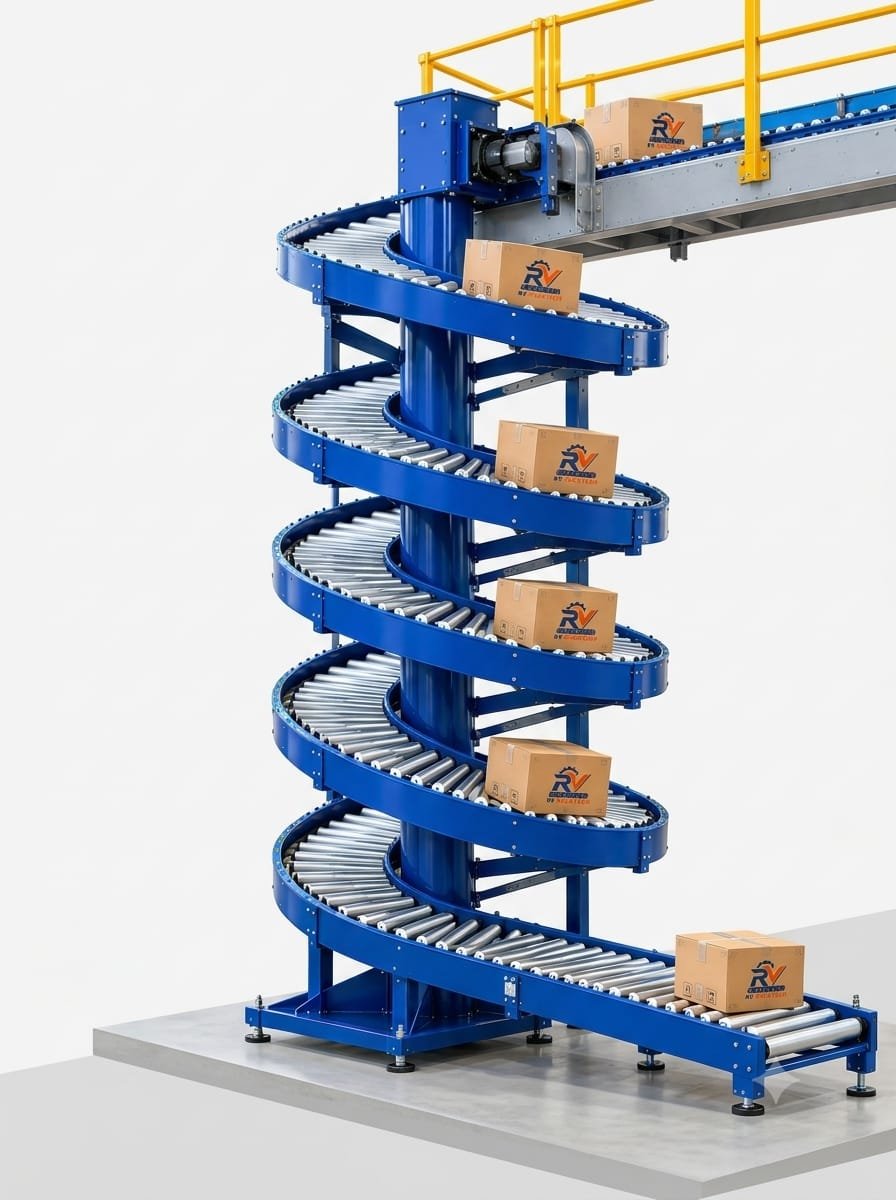
Spiral Gravity Roller Conveyor
Spiral Gravity Roller Conveyor moves cartons smoothly between different heights, saves floor space, and suits factories, warehouses, and packing lines.
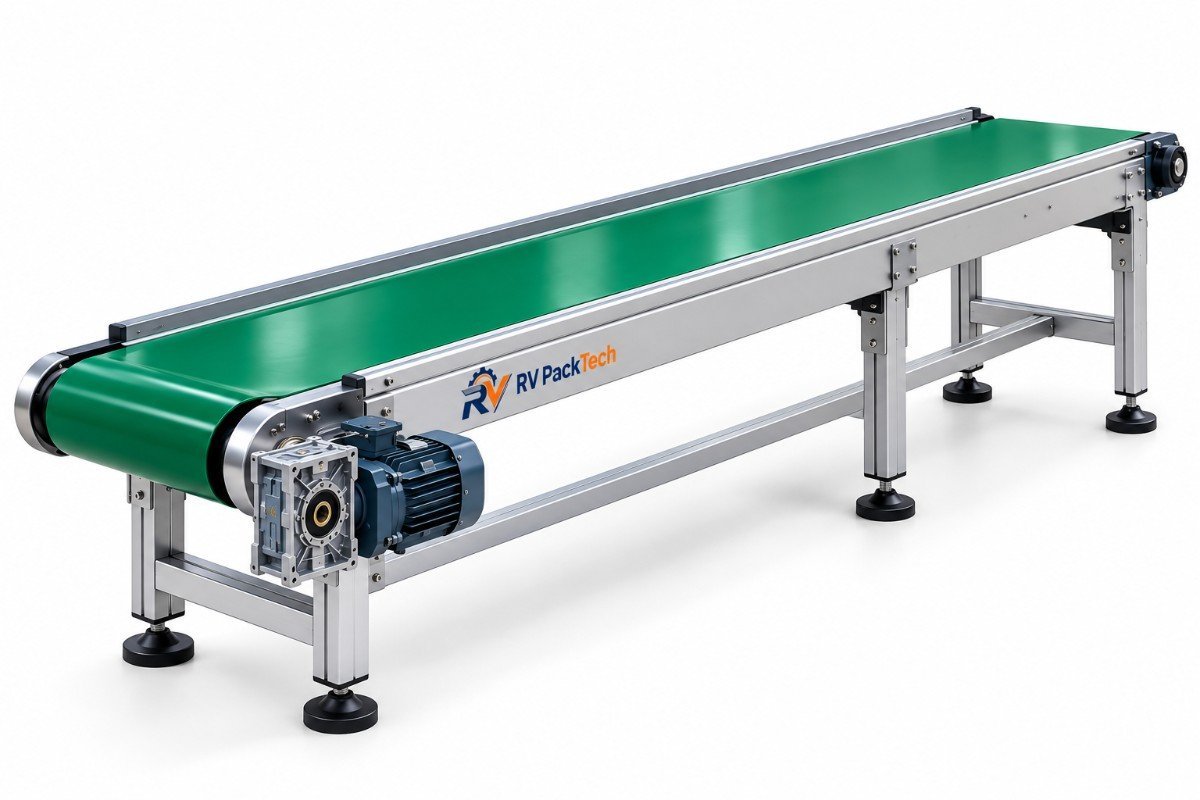
Belt Conveyor
Belt Conveyor for smooth and continuous material handling in factories, warehouses, and packing lines. Available in customized sizes.
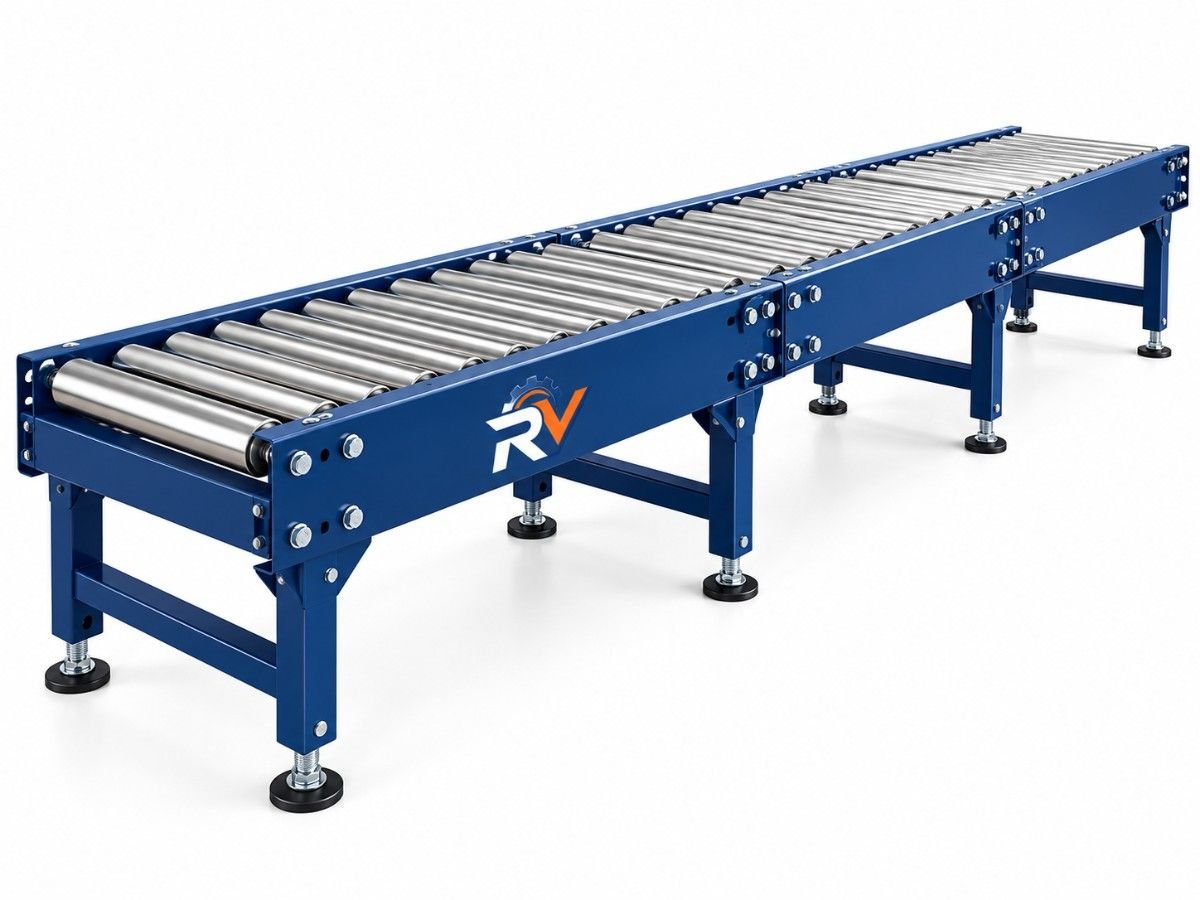
Roller Conveyor
Modular roller conveyors provide efficient material handling for manufacturing, packaging, and warehouse operations. Available in gravity, chain-driven, and motorized designs, they help transport cartons, boxes, totes, and pallets smoothly. Applications: - Packaging and assembly lines - Warehousing and dispatch - Carton and pallet handling - Manufacturing facilities Benefits: - Smooth material movement - Flexible configurations - Reduced manual handling - Efficient production workflows Looking for a reliable modular roller conveyor manufacturer in India? Contact RV PackTech for customized conveyor solutions.
Custom Machinery Design
Need a customized layout, specific motor brand or custom belt material? Our team responds within 24 hours.
Talk to Engineering